How to Support Lymphatic Drainage Naturally: Herbs and Habits
| The idea | Your lymphatic system has no pump — it flows when you move, hydrate and breathe. Support it with habits first, botanicals second. |
| Key habits | Daily movement, plenty of water, deep breathing, dry brushing, leg elevation. |
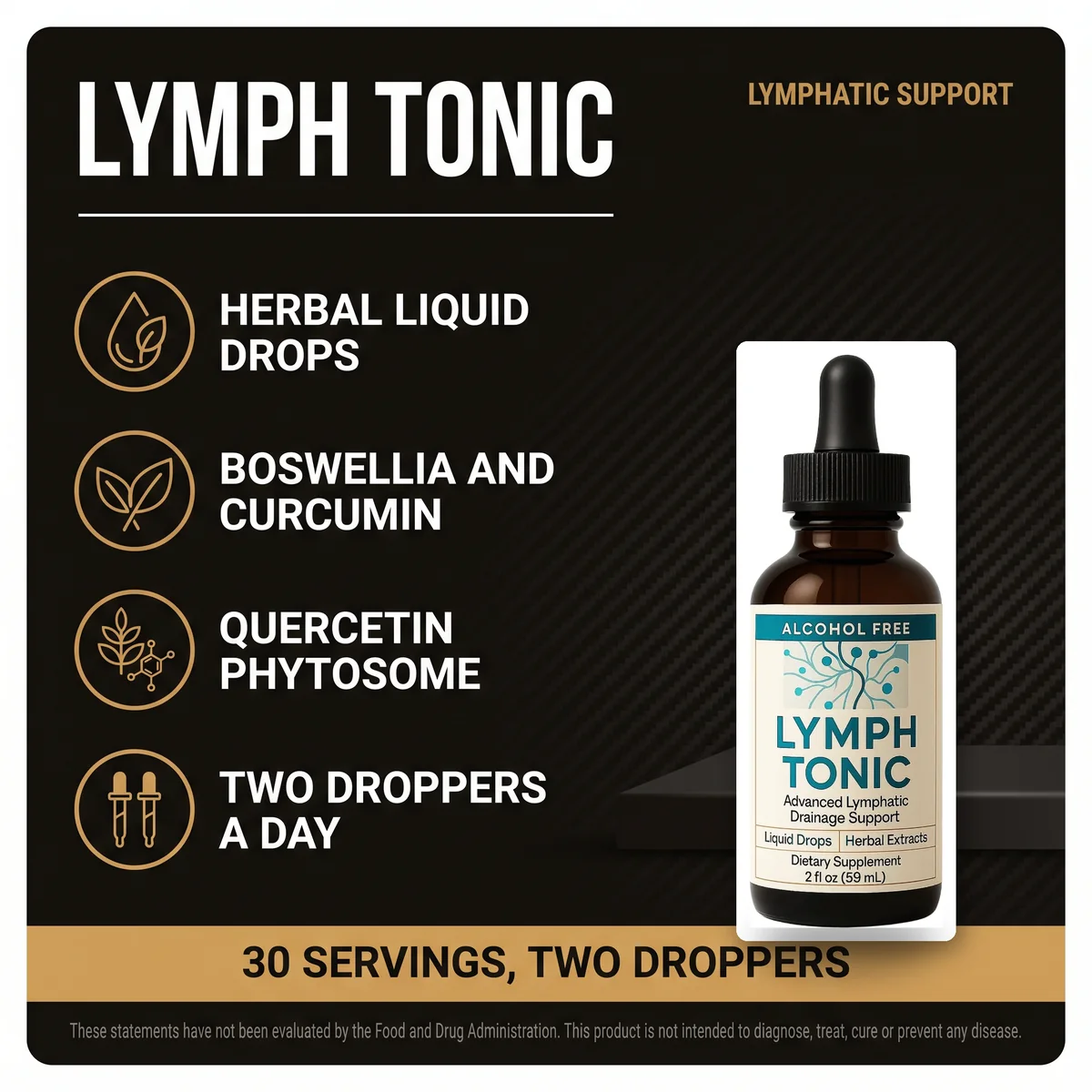
| Key botanicals | Boswellia, curcumin, horse chestnut, gotu kola, quercetin — the blend inside LymphTonic. |
Your lymphatic system is one of the hardest-working networks in your body and one of the least talked about. It is a web of vessels and nodes that carries excess fluid, waste and immune cells away from your tissues and back toward your bloodstream. When it flows well, you feel lighter and less puffy. When it stalls, you can feel heavy, swollen or simply “off.” The good news: supporting lymphatic drainage naturally is mostly about a handful of simple, repeatable habits — and a few well-chosen botanicals can round them out.
Why the lymphatic system needs your help
Unlike your cardiovascular system, which has the heart as a central pump, the lymphatic system has no pump of its own. It relies on three things to keep moving: the squeezing action of your skeletal muscles, the pressure changes of deep breathing, and adequate hydration to keep lymph fluid thin enough to flow. A modern, low-movement lifestyle — long hours at a desk, shallow breathing, not enough water — is exactly the combination that leaves drainage feeling sluggish.
That is why the most effective natural strategy is not a single miracle step but a stacked routine: move a little more, drink a little more, breathe a little deeper, and give your body botanicals traditionally associated with healthy circulation and a balanced inflammatory response.
Signs your lymphatic system could use support
There is no single test you can run at your kitchen table, but a few everyday signals often point to flow that has slowed down. Puffiness that comes and goes — especially around the ankles, fingers or under the eyes — is a common one, as is a general feeling of heaviness in the legs after a long day of sitting or standing. Some people notice they feel more sluggish during low-movement weeks, or that they bounce back more slowly after travel, when hours of sitting and dehydrated cabin air conspire against circulation. None of these is a diagnosis, and persistent or one-sided swelling always deserves a conversation with a clinician. But for the ordinary, low-grade heaviness that comes from a modern, sedentary routine, the natural levers below are exactly where to start.
It also helps to reframe the goal. You are not trying to “flush toxins” in a single dramatic session — that is marketing language, not physiology. What you are actually doing is giving a passive system the movement, water and gentle stimulation it needs to do its normal job well, day after day. That mindset shift, from quick fix to steady habit, is what makes natural lymphatic support actually work.
Five daily habits that keep lymph moving
1. Move often, not just hard. You do not need marathon workouts. Because muscle contraction is what physically pumps lymph, frequent gentle movement matters more than occasional intensity. A brisk ten-minute walk, a few minutes of rebounding on a mini-trampoline, stretching, or simply standing up every hour all help. If you take away one thing, make it this.
2. Hydrate consistently. Lymph is mostly water. When you are even mildly dehydrated, that fluid thickens and moves more slowly. Aim for steady water intake through the day rather than a big glass all at once, and lean on water-rich foods like cucumber, citrus and leafy greens.
3. Breathe deeply on purpose. The largest lymphatic vessel, the thoracic duct, runs through your chest, and the pressure changes from deep diaphragmatic breathing act like a secondary pump. A few rounds of slow belly breathing — in for four counts, out for six — several times a day gives your lymph a gentle push.
4. Try dry brushing and self-massage. Gently brushing the skin with a natural-bristle brush, always in strokes toward the heart, is a traditional practice for stimulating surface lymph flow. Light manual lymphatic massage, done in the same direction, follows the same logic.
5. Elevate and decompress. If your legs feel heavy by evening, elevating them above heart level for ten to fifteen minutes lets gravity assist drainage. Loosening tight waistbands and avoiding sitting cross-legged for hours helps too.
Make lymphatic support a one-step habit
LymphTonic puts thirteen botanicals into one alcohol-free daily dropper — an easy way to round out your movement-and-hydration routine. Backed by a 60-day guarantee.
See LymphTonic PackagesThe botanicals traditionally used for lymphatic support
Herbal traditions have long paired specific plants with circulation and drainage. These are the actives in the LymphTonic 600 mg blend, and why each earns a place:
- Boswellia serrata & curcumin — the frankincense-and-turmeric duo, used together to support a healthy, balanced inflammatory response, which underpins comfortable tissue and flow.
- Horse chestnut — a classic vein-tone botanical, traditionally taken for heavy, tired legs and healthy circulation.
- Gotu kola — an ayurvedic herb long associated with connective tissue and microcirculation.
- Quercetin phytosome & hesperidin — plant flavonoids valued for antioxidant support and capillary strength; the phytosome form is designed for better absorption.
- Ginger & black pepper — warming botanicals; piperine from black pepper also helps the body absorb curcumin.
None of these is a substitute for movement and hydration. Think of botanicals as the layer that complements the habits — not a shortcut around them.
Putting it into a simple daily routine
Here is a realistic day that stacks the pieces without taking over your life. On waking, drink a large glass of water and take your LymphTonic drops. Mid-morning, stand and stretch or take a short walk. At lunch, add a water-rich food and do a minute of deep breathing. In the afternoon, break up sitting every hour. In the evening, dry brush before a shower and elevate your legs while you wind down. It is the consistency, not the intensity, that pays off.
Give any natural approach several weeks of steady practice before you judge it. Drainage responds to routine, and routines take time to build. Individual results vary and are not guaranteed — but the habits above cost almost nothing and support far more than lymph alone.
What the physiology literature supports, and what it does not
Everything sensible in this guide rests on one anatomical fact: the lymphatic system has no central pump. Its vessels move fluid through their own rhythmic contraction plus the external pressure changes supplied by muscle activity and breathing (Lymphatic anatomy and biomechanics, The Journal of Physiology, 2011). That is why movement and breathing appear on every credible list and why passive treatments do not.
The breathing part is more than a relaxation cue. An ultrasound study of the terminal thoracic duct measured its diameter changing with respiration and body position, showing that the duct where lymph re-enters the bloodstream genuinely responds to how you breathe and how you lie (The effect of respiration and body position on terminal thoracic duct diameter and the lymphovenous junction, Clinical Anatomy, 2022). What the literature does not support is the commercial framing around all of this: a critical review of detox diets found no convincing human evidence that commercial detox and cleanse regimens eliminate toxins or improve health outcomes (Detox diets for toxin elimination and weight management: a critical review of the evidence, Journal of Human Nutrition and Dietetics, 2015). So keep the habits and drop the promises. For the symptoms people usually arrive with, see the signs of a sluggish lymphatic system; for the movement that does the mechanical work, the best exercises to reduce water retention; for the skin ritual and its real limits, dry brushing for lymphatic drainage; and for the biggest modern obstacle, how sitting all day affects circulation.
Frequently asked questions
What causes a sluggish lymphatic system?
The lymphatic system has no central pump, so it relies on muscle movement, breathing and hydration to keep moving. Long periods of sitting, dehydration, a low-movement lifestyle and poor sleep can all leave lymph flow feeling sluggish. Gentle daily movement is the single most reliable way to support it.
Which herbs are traditionally used for lymphatic support?
Boswellia serrata and curcumin are used for a balanced inflammatory response, horse chestnut and gotu kola for healthy circulation and vein tone, and quercetin and hesperidin as antioxidant flavonoids. Ginger supports circulation and digestion. These are the botanicals featured in LymphTonic’s 600 mg blend.
How long does it take to notice a difference?
Natural approaches work gradually. Most people give a combination of daily movement, hydration and botanical support several weeks of consistent use. Individual results vary and are not guaranteed.
Can I support lymphatic drainage without supplements?
Yes. Movement, hydration, deep breathing, dry brushing and elevating the legs all help. Botanical supplements like LymphTonic are meant to complement those habits, not replace them.
- National Cancer Institute — Definition: lymphatic system.
- Cleveland Clinic — Lymphatic System: overview and function.
- National Center for Complementary and Integrative Health — Turmeric & curcumin research summary.
- The Journal of Physiology — Lymphatic anatomy and biomechanics (2011, PMID 21486777).
- Clinical Anatomy — The effect of respiration and body position on terminal thoracic duct diameter and the lymphovenous junction: An exploratory ultrasound study (2022, PMID 34658062).
- Journal of Human Nutrition and Dietetics — Detox diets for toxin elimination and weight management: a critical review of the evidence (2015, PMID 25522674).
† These statements have not been evaluated by the FDA. This product is not intended to diagnose, treat, cure or prevent any disease. This article is for general information only and is not medical advice.